
Tony Dong, CETF®
Founder, ETF Portfolio Blueprint
Lead ETF Analyst, ETF Central

Examine the regulatory framework, portfolio construction, and key product variations that distinguish money market ETFs from their mutual fund counterparts.
Money market funds have quietly become one of the largest corners of the global asset management industry. According to the Federal Reserve Bank of St. Louis, total financial assets held in U.S. money market funds reached a record $8.29 trillion in the first quarter of 2026.
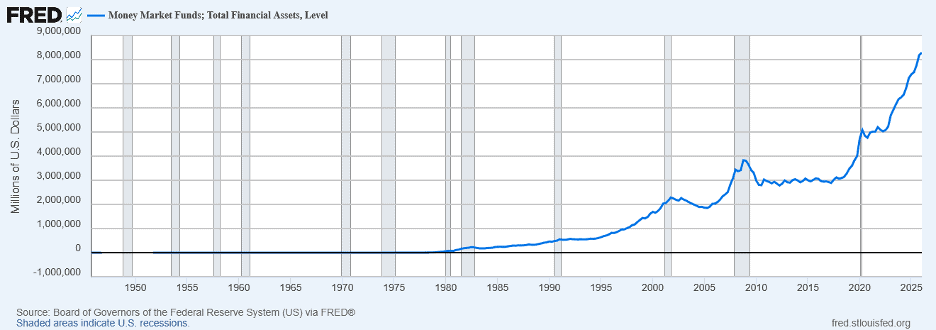
Source: FRED, as of July 31st, 2026
Money market balances are often viewed as a proxy for the market’s “dry powder.” While not every dollar sitting in a money market fund is waiting to be deployed into stocks, elevated balances suggest that investors continue to value liquidity and capital preservation over taking additional risk.
Part of that is simply a function of today’s interest rate environment. Under Chairman Kevin Warsh, the Federal Reserve has now held the federal funds target range at 3.50% to 3.75% for a fifth consecutive meeting. As a result, money market investors have been able to earn yields well above what was available for much of the previous decade while assuming relatively little risk.
The industry itself has also changed considerably since the 2008 financial crisis. Many investors will remember the collapse of the Reserve Primary Fund, which “broke the buck” after suffering losses on Lehman Brothers commercial paper. Breaking the buck refers to a money market fund’s net asset value falling below its intended stable $1.00 per share net asset value (NAV).
In response, regulators implemented a series of structural reforms, including stricter liquidity requirements, enhanced portfolio quality standards, and new redemption and liquidity rules designed to improve the resilience of money market funds during periods of market stress.
Even this traditionally conservative corner of asset management continues to evolve. One of the more notable developments in recent years has been the arrival of money market ETFs.
That’s also where many investors become confused. Because ETFs trade on exchanges while traditional money market funds operate as mutual funds, many assume the products are fundamentally different or subject to entirely different rules.
In reality, they share many similarities alongside several important structural distinctions. In today’s ETF Institute column, we’ll separate fact from fiction by explaining how money market ETFs work, the regulations that govern them, how they differ from traditional money market mutual funds, and some of the leading options currently available to investors.
How Are Money Market ETFs Regulated?
Unlike most fixed-income ETFs, money market ETFs must comply with one of the most stringent sets of portfolio regulations in the investment industry: SEC Rule 2a-7. Rule 2a-7 is essentially the rulebook that defines what qualifies as a money market fund. Its primary objective is to make these funds resilient, liquid, and transparent enough to meet shareholder redemptions even during periods of market stress.
One of its most important features is the liquidity requirement. Government and prime money market funds generally must maintain at least 25% of total assets in daily liquid assets and at least 50% in weekly liquid assets. These are defined as securities that can readily be converted into cash within one or five business days, respectively.
Prime money market funds are generally considered the riskier category because they may invest in high-quality short-term corporate obligations. These commonly include commercial paper, certificates of deposit, promissory notes, bankers’ acceptances, and other short-dated corporate debt securities. While these instruments typically offer somewhat higher yields than government securities, they also introduce modest credit risk.
Government money market funds, by contrast, operate under much stricter portfolio constraints. To use the “government money market fund” designation, at least 99.5% of total assets must be invested in cash, U.S. Treasury securities, obligations issued or guaranteed by U.S. government agencies, or repurchase agreements fully collateralized by those securities or cash. As a result, these funds generally carry lower credit risk, albeit often with slightly lower yields.
The important takeaway is if an ETF wants to market itself as a money market fund, it must satisfy the same Rule 2a-7 requirements governing liquidity, portfolio quality, maturity, and transparency that apply to traditional money market mutual funds.
The Trading Mechanics of Money Market ETFs
Traditional money market mutual funds are designed to maintain a fixed $1.00 per share NAV. Purchase and redemption orders are queued throughout the trading day and executed once, after the market closes, at that fixed price.
Money market ETFs operate differently because they trade on stock exchanges. Rather than maintaining a fixed share price, the NAV of a money market ETF is designed to float. The floating NAV means investors may observe small day-to-day fluctuations in principal, although these are generally minimal.
A typical money market ETF might begin a new distribution period with a net asset value around $100 per share. As interest accrues throughout the month, the NAV gradually rises. On the ex-distribution date, it drops by the amount of the upcoming payout before the process begins anew.
Over time, this creates the familiar “sawtooth” price pattern visible in examples such as the iShares Government Money Market ETF (GMMF).

Like any ETF, investors buy and sell shares throughout the trading day at the prevailing market price. That market price can differ slightly from the ETF’s underlying NAV. In practice, however, those differences tend to remain minimal because the ETF’s in-kind creation and redemption mechanism gives authorized participants an incentive to arbitrage away meaningful premiums or discounts.
The ETF structure also introduces a few trading considerations that mutual fund investors don’t need to think about. With a money market mutual fund, you simply submit your order and receive that day’s closing $1.00 NAV per share. ETF investors, by contrast, transact on an exchange and therefore must cross the bid-ask spread.
While money market ETFs are generally among the tightest-trading ETFs on the market, those transaction costs still exist. For that reason, it’s worth paying attention to an ETF’s 30-day median bid-ask spread. Many of the larger money market ETFs consistently trade with spreads around 0.01%.
Good ETF trading habits also matter. Using limit orders instead of market orders can help control execution prices, and investors should generally avoid trading during the first and last 15 minutes of the trading day, when bid-ask spreads are often at their widest and market volatility tends to be elevated.
Finally, most money market ETFs pay distributions monthly, mirroring traditional money market mutual funds. However, that is no longer the only option. As we’ll see later, several newer money market ETFs have adopted weekly distribution schedules, providing investors with more frequent cash flows.
Notable Money Market ETFs Available Today
According to ETF Central’s screening tool, there are currently 9 money market ETFs available to U.S. investors. The lineup includes products from established asset managers, boutique ETF issuers, and, perhaps surprisingly, one of the largest providers of leveraged and inverse ETFs.
The clear market leader is the ProShares GENIUS Money Market ETF (IQMM), currently the largest ETF in the category at $17.39 billion in AUM. The “Genius” branding isn’t simply a marketing term. It refers to the Guiding and Establishing National Innovation for U.S. Stablecoins (GENIUS) Act.
IQMM was specifically structured so that its underlying assets qualify as eligible reserve assets under the legislation. That gives ProShares the opportunity to market the ETF to stablecoin issuers as an alternative to traditional reserve vehicles such as money market mutual funds or Treasury bills. According to ETF.com, this positioning could create an entirely new institutional distribution channel.
ProShares has also found another use for the fund. A portion of IQMM’s assets comes from the firm using the ETF internally as collateral for parts of its leveraged, inverse, and futures-based ETF lineup, helping explain its rapid asset growth relative to other money market ETFs.
Outside of ProShares, BlackRock has established a strong presence in the category through iShares. In addition to the previously discussed GMMF, investors can also choose the iShares Prime Money Market ETF (PMMF). Both charge the same 0.20% expense ratio, but PMMF’s allocation to commercial paper and other eligible prime money market securities allows it to generate a higher seven-day SEC yield of 3.68%, compared with approximately 3.50% for the government-only GMMF.
Two other noteworthy entrants are the Texas Capital Government Money Market ETF (MMKT) and the JPMorgan 100% U.S. Treasury Securities Money Market ETF (JMMF). Both distinguish themselves by making weekly rather than monthly distributions. The JPMorgan fund is also notable from a tax perspective because it invests exclusively in U.S. Treasury securities, meaning its interest income is generally exempt from state and local income taxes.
Beyond those larger names, investors can also find money market ETFs from issuers including Simplify Asset Management, Charles Schwab, Rareview Capital, and State Street. Given the rapid growth of the category, I wouldn’t be surprised to see additional entrants over the next few years.
Large ETF providers such as Vanguard and Invesco have yet to launch dedicated money market ETFs, but they have obvious incentives to do so, whether to support their own product ecosystems or provide advisors with another cash management tool.
About Tony Dong
Tony is the founder of ETF Portfolio Blueprint and the Lead ETF Analyst for ETF Central, a partnership between Trackinsight and the New York Stock Exchange. He also currently writes freelance for MoneySense, U.S. News & World Report, Kiplinger, and 24/7 Wall St., and runs an investing-focused newsletter called The Dumb Money Dispatch with 3,300+ subscribers.
Outside of finance, Tony owns a small ranch in rural British Columbia, raising goats and chickens, and also volunteers as a wildland firefighter in his local community. His background includes service in the Canadian Armed Forces as a reservist and stints in corporate security.